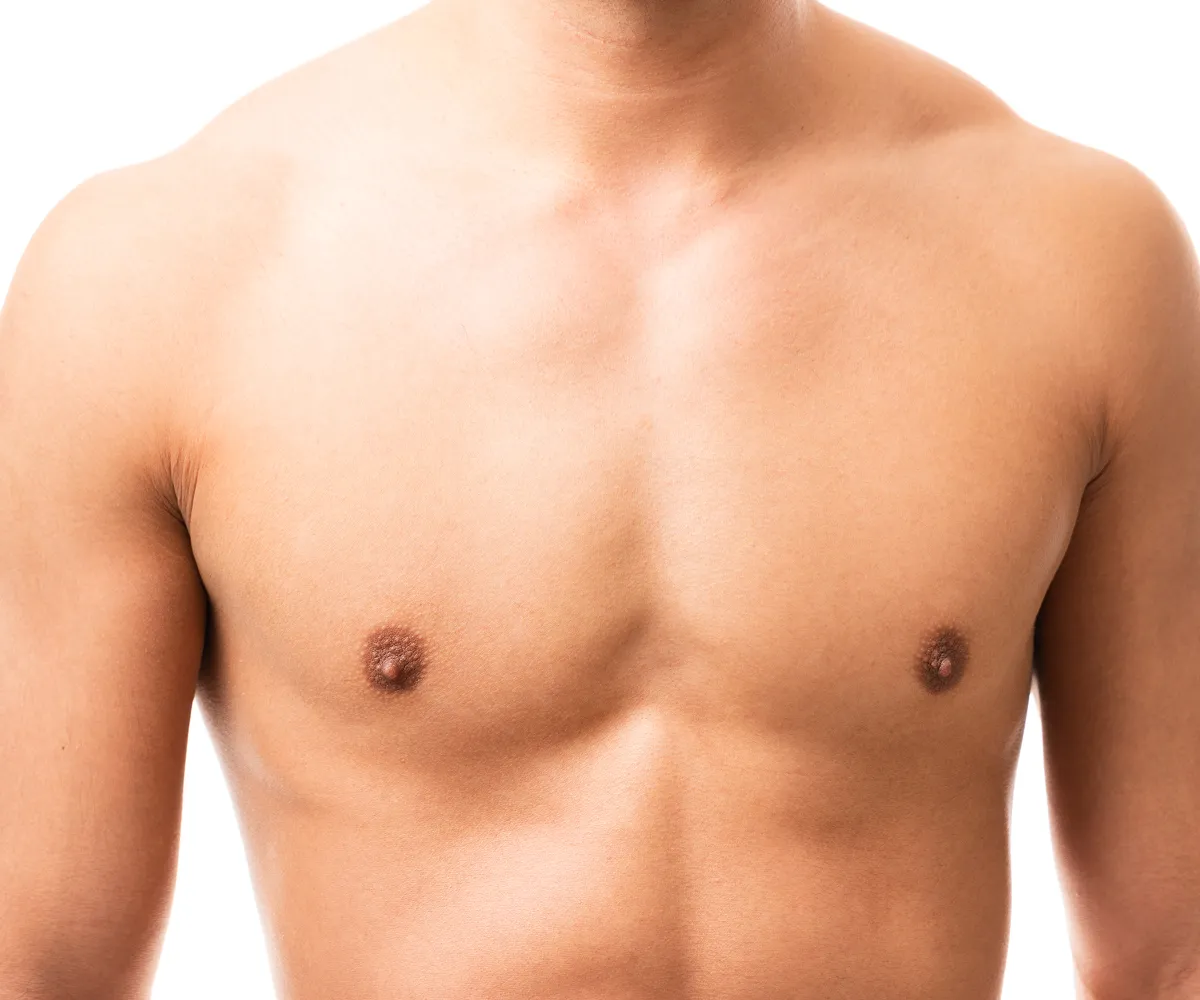
A chest that feels more like you — with personalized surgical care.
For many trans men and nonbinary people, top surgery is an important part of feeling more comfortable in their bodies. Your goals and preferences guide the conversation.
Masculinizing mastectomy — internationally known as top surgery — is the bilateral removal of breast tissue with remodeling of the chest to create a male contour. For most patients, it is the intervention with the greatest positive impact on psychosocial well-being, body image and patient-reported quality of life. It is also often the first surgery of the gender affirmation process — and therefore deserves careful, precise technical planning and a truly welcoming care environment.
Dr. Alexandre Charão — plastic surgeon recognized by SBCP, AMB and CFM, and a member of BAPS, performing body contouring surgery since 2004 and a clinic in Botafogo, Rio de Janeiro — offers four distinct technical approaches to top surgery (masculinizing mastectomy), selected based on breast volume, degree of ptosis and skin elasticity, according to surgical classification algorithms.
Which Top Surgery Approach May Be Right for You?
The choice of technique determines the size of the scars, the position of the nipple-areola complex and the quality of the final result.
Periareolar technique (minimal scar)
Suitable for small breast volumes and skin with good elasticity. The glandular resection is performed by incision around the areola, without additional scarring. It leaves the smallest possible scar, with natural positioning of the nipple-areola complex. A systematic review of 2,138 breasts shows that periareolar cutaneous resection is used in 34.1% of cases.
Semicircular or Spindle Technique
For moderate volumes with mild ptosis, the spindle-shaped or semicircular incision around the areola allows greater resection while keeping the scar contained. The dermal flap of the nipple-areola complex preserves innervation and vascularization. A series of 220 mastectomies documents this technique in patients with moderate volume.
Double Incision with Free Graft
For large volumes and skin with little elasticity — the most common technique, representing 42.2% of cases in the literature1. Complete bilateral mastectomy is performed through two horizontal incisions in the inframammary region, with repositioning of the nipple-areola complex as a free graft in the ideal male position. A series of 72 patients2 documents a major complication rate of 8.3%, with a high-quality masculine chest result.
Inframammary Fold with Skin Resection
For cases with significant ptosis and excess skin. It combines glandular resection with skin resection through the inframammary fold, placing the scar along the chest's natural curve. An analysis of 755 cases from the ACS NSQIP database shows that mastectomy and breast reduction are equally safe for masculinizing chest reconstruction, with no significant difference in the rate of complications between approaches.
What is recovery like — and who supports you along the way?
The postoperative period of top surgery is a transition stage — and you don't walk this path alone.
Fast Track Recovery — a faster, more comfortable recovery and refined scars — is applied to all masculinizing mastectomies, aligned with accelerated recovery protocols in breast surgery, with multimodal analgesia starting in the operating room to minimize discomfort in the first 48 hours. The Weight-Loss and Metabolic Preparation Method optimizes nutritional status and healing capacity before surgery, in line with perioperative nutritional and metabolic support guidelines.
Each patient receives an exclusive WhatsApp group with direct access to Dr. Charão throughout the postoperative period — for questions about the scar, care instructions and support at any time. Care is provided with complete confidentiality, respect, and a welcoming approach. The career of Dr. Alexandre Charão (SBCP and BAPS) includes national and international recognition in body contouring.
All surgeries are performed at Hospital Glória D'Or, Glória neighborhood, South Zone of Rio de Janeiro — part of the D'Or Network, with annual JCI accreditation. The clinic in Botafogo is also in the South Zone, which makes preoperative and postoperative visits easier. Journalists from The Washington Post accompanied Dr. Charão's work, and O Globo’s “Faz a Diferença” Award (2006) reflects a track record of excellence in body contouring surgeries that embraces the full diversity of patients treated.
Technical Comparison of Procedures
Understand the differences between the conventional approach and mastectomy with Dr. Alexandre Charão:
| Criteria | Conventional approach | Top Surgery — Dr. Alexandre Charão |
|---|---|---|
|
Available techniques
|
• Often a single approach | ✓ Four techniques with indication based on anatomy and volume |
|
Scar planning
|
• Standard, not individualized | ✓ Optimized scar positioning for each anatomy |
|
Nipple-areola complex
|
• Variable repositioning | ✓ Free graft or dermal flap as indicated |
|
Evidence base
|
• Variable | ✓ Systematic review of 2,138 breasts + ACS NSQIP series of 755 cases |
|
Recovery
|
✕ 8 to 12 weeks of restrictions | ✓ Fast Track Recovery: faster, more comfortable recovery |
|
Preoperative preparation
|
• Fasting and basic tests | ✓ Weight-Loss and Metabolic Preparation Method |
|
Post-op monitoring
|
• Appointments at fixed intervals | ✓ Exclusive WhatsApp Group with direct access to Dr. Charão |
|
Surgical center
|
• Variable | ✓ Hospital Glória D'Or (Glória, South Zone) — D'Or Network, JCI |
Frequently Asked Questions
01 What Top Surgery Options Are Available?
Four approaches are used: periareolar (minimal scar for small volumes), semicircular/spindle with dermal flap (moderate volumes with mild ptosis), double incision with free graft of the nipple-areola complex (large volumes, the most common technique — 42.2% of cases), and inframammary fold technique for significant ptosis, aligned with the safety evidence of ACS NSQIP. The indication is defined in the individual assessment.
02 Does the double incision leave a permanent scar?
Yes. The double incision with free graft leaves two horizontal scars in the inframammary region — which fade over time but are permanent. On the other hand, it is the technique that produces the most masculine and definitive result for large volumes. The precise planning of scar positioning is an essential part of the preoperative consultation.
03 Is it possible to perform mastectomy with minimal scarring?
Yes, for small volumes with good skin elasticity. The periareolar or semicircular/spindle technique allows results with scarring restricted to the contour of the areola or the inferolateral region. The indication depends on the volume and quality of the skin — clinically evaluated by Dr. Charão.
04 Does the nipple-areola complex lose sensation after surgery?
In free grafting techniques, sensitivity may be partially affected and recover over several months. In dermal flap techniques (periareolar and semicircular), the preservation of innervation tends to be superior. Dr. Charão discusses these differences with each patient during surgical planning.
05 What documents are needed for surgery?
Dr. Charão performs individualized clinical evaluation. Psychological or psychiatric reports can be requested according to the WPATH (World Professional Association for Transgender Health) guidelines and the current rules of the CFM. The consultation is the time to clarify all requirements.
06 How are care and confidentiality handled at the clinic?
Care at Dr. Charão's clinic is provided with total respect, acceptance and confidentiality. The consultation, surgery and postoperative process are conducted with the same individualized care offered to all patients — with direct access to the doctor via the exclusive WhatsApp group during the entire recovery. See Dr. Alexandre Charão's background.
07 How long does recovery take with Fast Track Recovery?
With Fast Track Recovery, aligned with accelerated recovery protocols, the return to light activities takes 7 to 10 days. A chest compression binder is recommended for 4 to 6 weeks. Physical activity is gradually cleared from weeks 4 to 6. The exclusive WhatsApp group ensures monitoring and support throughout the process.
08 Where does Dr. Charão perform top surgery?
At Hospital Glória D'Or, Glória neighborhood, South Zone of Rio de Janeiro — part of the D'Or Network, with annual JCI accreditation. The consultation clinic is in Botafogo, also in the South Zone. Care in Portuguese, English and French for patients from Brazil and abroad. Metabolic Preparation can be initiated as soon as surgery is scheduled.
Ready for skilled, confidential and respectful care?
Schedule a face-to-face consultation in Botafogo or an exclusive teleconsultation directly with Dr. Alexandre Charão's team.
📅 Ask About Top Surgery📚 Scientific Bibliography
- Wilson SC, Morrison SD, Anzai L, et al. Masculinizing top surgery: a systematic review of techniques and outcomes. Ann Plast Surg. 2018;80(6):679-683. doi:10.1097/SAP.0000000000001354
- Naides AI, Schultz JJ, Shulzhenko NO, Keith JD. Chest masculinization technique and outcomes in 72 double-incision chest-contouring procedures with free nipple grafting. Plast Reconstr Surg Glob Open. 2021;9(3):e3459. doi:10.1097/GOX.0000000000003459