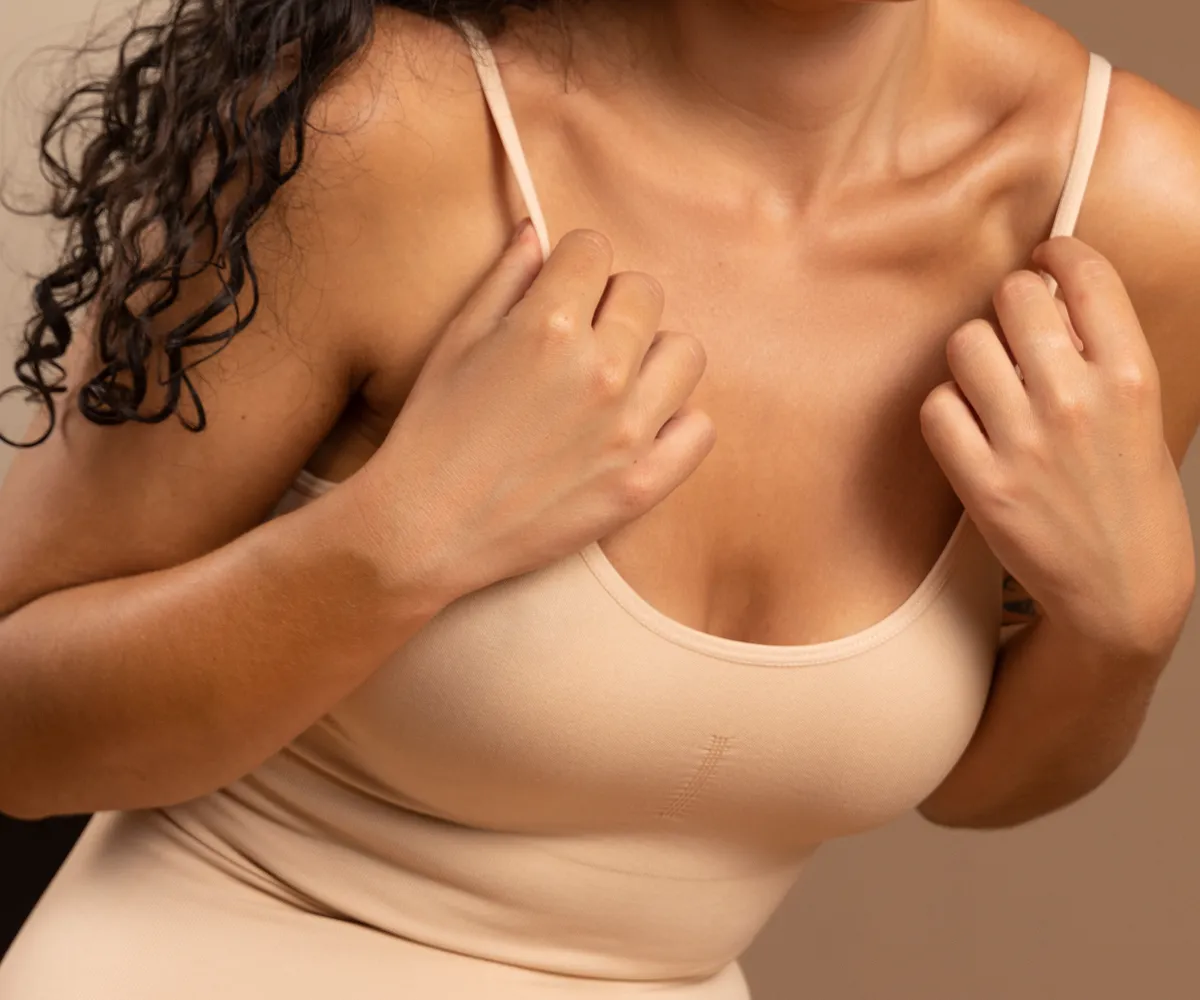
Want a breast lift without implants? Or more fullness with implants?
Yes. Depending on the degree of ptosis and the volume available, it is possible to reposition and remodel without any implant — using only your own tissue.
A breast lift, also called mastopexy, is a surgery that repositions the nipple-areola complex, removes excess skin and reshapes the breast tissue to restore a younger, firmer contour. Pregnancy, breastfeeding, weight loss or simply time — the triggers for breast ptosis (sagging) are many, and the result tends to be the same: sagging breasts without projection, which may still have volume but have lost their shape.
With more than 200 real patient reviews on Google and a career dedicated to body contouring since 2004, Dr. Alexandre Charão, a plastic surgeon recognized by SBCP, AMB and CFM, and a member of BAPS, with a clinic in Botafogo and surgeries performed at Hospital Glória D'Or (Glória neighborhood, South Zone of Rio), offers three distinct approaches to mastopexy, chosen based on the degree of ptosis, the available volume and each patient's aesthetic goals.
What are the three approaches, and when is each one indicated?
The right technique is not the most popular — it is the one that respects what you have and delivers what you want.
Breast lift without implants — Reshaping with your own tissue
For patients with adequate breast volume and moderate to severe ptosis, mastopexy without implants has a relatively low complication rate in the literature1. The glandular tissue is reshaped internally to create projection and support, while excess skin is removed. The superomedial pedicle technique — validated in a meta-analysis of 5,123 breasts2 — shows higher BREAST-Q satisfaction scores, shorter surgical time and a lower infection rate compared to the conventional inferior pedicle.
Breast lift with implants — Simultaneous lift and augmentation
When ptosis comes with a lack of volume, combining a lift with an implant corrects both problems in a single surgery. Dr. Charão applies the inferolateral muscle sling technique described in the Brazilian literature in PRS Global Open for implant stability and long-term support, preventing recurrent ptosis. Implant selection follows the High Five™ system, with objective, individualized anatomical criteria.
Breast lift with fat transfer — A natural lift with your own fat
For patients seeking natural results without implants, or who only need a subtle volume boost along with reshaping, this approach uses the patient's own fat to fill the upper pole and improve the contour. Mastopexy with autologous fat transfer was documented in a Brazilian series as an implant-free alternative, with a low rate of serious complications. A prospective study of 106 vertical mastopexy cases reported 94.3% satisfaction and 89.3% improvement in self-esteem.
What makes the result last?
A beautiful result in the first month is easy. A beautiful result in 5 years requires technical planning.
Recurrent ptosis is the main concern after any mastopexy. Dr. Charão reduces this risk with two elements: the right choice of pedicle technique — with the advantages of the superomedial pedicle documented in a meta-analysis (BREAST-Q, surgical time and infection) — and the Weight-Loss and Metabolic Preparation Method, aligned with perioperative nutritional and metabolic support guidelines, which prepares the tissue to heal better.
Fast Track Recovery — a faster, more comfortable recovery and refined scars — is applied to all mastopexies, with a private WhatsApp group for each patient throughout the postoperative period, in line with accelerated recovery protocols in breast surgery. In 2006, O Globo's "Faz a Diferença" (Makes a Difference) Award recognized the real impact of Dr. Charão's work, and journalists from The Washington Post came to Rio de Janeiro specifically to follow his body contouring surgeries — recognition that reflects decades of consistent results.
Surgeries are performed at Hospital Glória D'Or, in the Glória neighborhood, South Zone of Rio de Janeiro — part of the D'Or Network, the largest hospital network in Brazil, with annual Joint Commission International (JCI) accreditation. The clinic is in Botafogo, near the hospital, making it easy to get around before and after surgery.
Technical Comparison of Procedures
Understand the differences between conventional mastopexy and Dr. Alexandre Charão's approach:
| Criteria | Conventional mastopexy | Dr. Alexandre Charão |
|---|---|---|
|
Available approaches
|
• Usually one standard technique | ✓ Three options: without implants, with implants (sling) and with fat transfer |
|
Pedicle technique
|
• Inferior pedicle as default | ✓ Superomedial: higher BREAST-Q satisfaction, lower infection rate |
|
Long-term support
|
• Depends on sutures | ✓ Inferolateral muscle sling validated in Brazilian literature |
|
Implant selection
|
• Based on preference or availability | ✓ High Five™ System — objective anatomical measurements |
|
Implant-free alternative
|
• Rarely combined with fat transfer | ✓ Mastopexy with autologous fat transfer — Brazilian series |
|
Postoperative recovery
|
• 8 to 12 weeks of restrictions | ✓ Fast Track Recovery: faster, more comfortable recovery |
|
Post-op monitoring
|
• Consultations at fixed intervals | ✓ Exclusive WhatsApp group with direct access to the doctor |
|
Surgical center
|
• Variable | ✓ Hospital Glória D'Or (Glória, South Zone) — D'Or Network, annual JCI accreditation |
Frequently Asked Questions
Straightforward answers about breast lift surgery.
01 — What is the difference between mastopexy with and without implants?
Without implants, the volume comes from reshaping the existing breast tissue — an approach with a relatively low complication profile in the systematic review of implant-free mastopexy, indicated for those who have enough volume and just want to lift and firm. With implants, the lift and augmentation are done at the same time with an inferolateral muscle sling — indicated for ptosis combined with a lack of volume. Those focused on implants may also want to learn about advanced breast augmentation techniques. The indication depends on an individual anatomical evaluation.
02 — What is mastopexy with fat transfer, and who is it for?
It combines a breast lift with the patient's own fat to fill the upper pole. It suits those seeking natural results without implants and a subtle volume boost. It was documented in a Brazilian series of mastopexy with fat transfer, with a low rate of serious complications.
03 — Why is the superomedial pedicle preferable to the inferior pedicle?
A meta-analysis of 5,123 breasts shows higher BREAST-Q satisfaction, shorter surgical time and fewer infections with the superomedial pedicle. It is Dr. Charão's preferred approach for the vast majority of mastopexies, with the final indication defined by individual anatomy.
04 — Is mastopexy with implants riskier?
The combination is technically more demanding than a mastopexy alone. That is why Dr. Charão uses the inferolateral muscle sling and the High Five™ system to plan the implant with anatomical criteria and aim for a lasting result. Rigorous planning is what separates a lasting result from a temporary one.
05 — How long does a mastopexy result last?
It depends on the technique, tissue quality and lifestyle. The superomedial pedicle and muscle sling, combined with Metabolic Preparation that optimizes tissue quality before surgery, contribute to greater durability. Significant weight changes after surgery may compromise the long-term outcome.
06 — Does Fast Track Recovery apply to mastopexy?
Yes. Fast Track Recovery — a faster, more comfortable recovery and refined scars — is applied to all mastopexies, aligned with accelerated recovery protocols in breast surgery. The private WhatsApp group guarantees direct access to Dr. Charão for scar monitoring and continuous support throughout the postoperative period.
07 — Is mastopexy possible after breastfeeding?
Yes, and it is one of the most common indications. It is recommended to wait at least 6 months after you stop breastfeeding so the breast tissue can stabilize its volume. Dr. Charão evaluates each case individually and defines the most appropriate approach — with or without implants, with or without fat transfer.
08 — Where does Dr. Charão perform mastopexy?
Surgeries are performed at Hospital Glória D'Or, in the Glória neighborhood, South Zone of Rio de Janeiro — part of the D'Or Network, with annual JCI accreditation. The clinic is in Botafogo, also in the South Zone, making it easy to get around before and after surgery.
Do you want to restore the shape of your breasts — including shorter-scar techniques when appropriate, and direct follow-up from your surgeon?
Schedule your consultation with Dr. Alexandre Charão. The approach (without implants, with implants or with fat transfer) is chosen during the consultation, based on your anatomy.
Chat on WhatsApp nowReferences
- di Summa PG, Oranges CM, Watfa W, et al. Systematic review of outcomes and complications in nonimplant-based mastopexy surgery. J Plast Reconstr Aesthet Surg. 2019;72(2):243-272. doi:10.1016/j.bjps.2018.10.018
- Tanas Y, Tanas J. Comparative outcomes of superomedial and inferior pedicles in breast reduction and mastopexy: a meta-analysis of 5,123 breasts. Aesthetic Plast Surg. 2025;49:1327-1339. doi:10.1007/s00266-024-04389-0