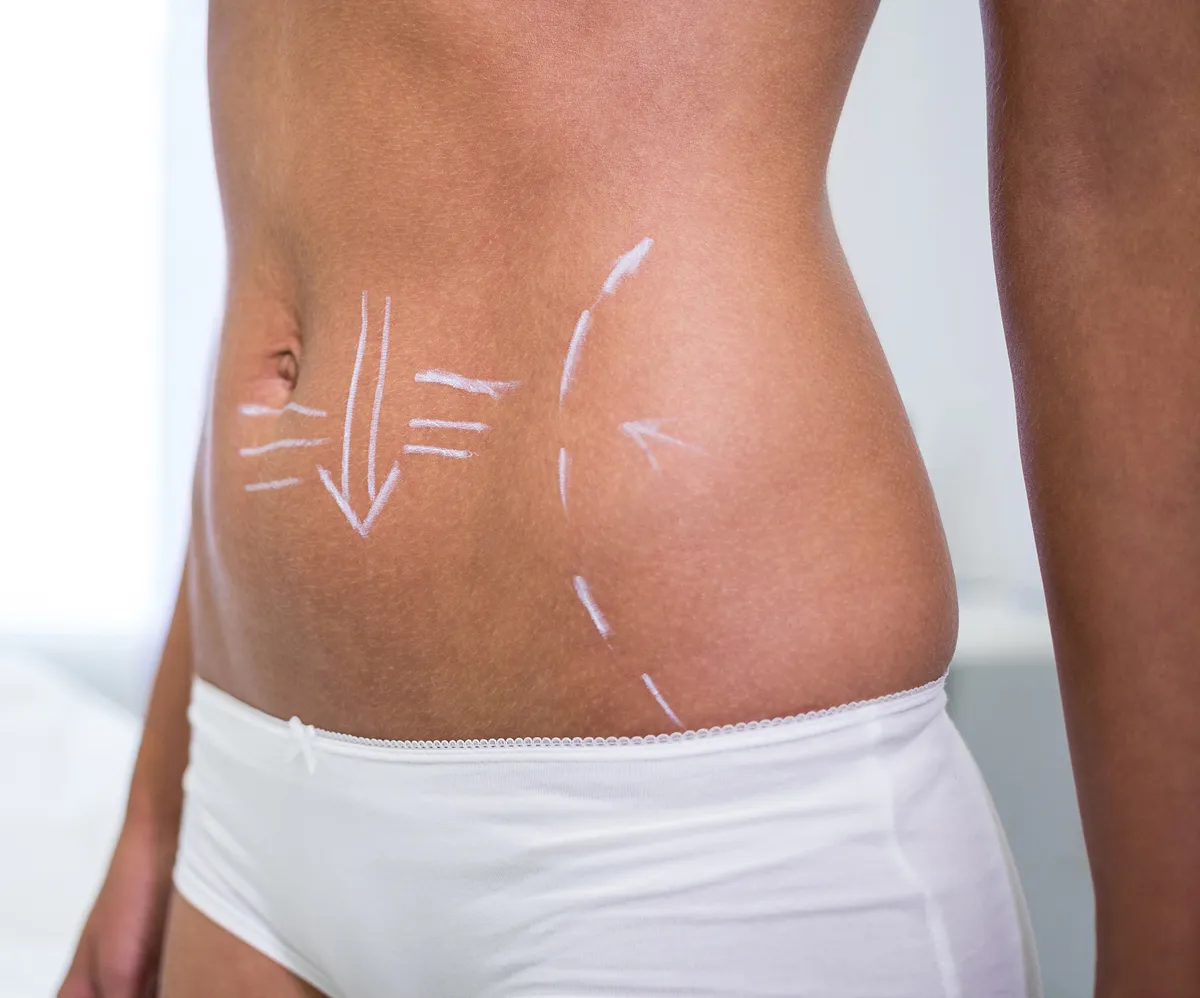
Already have a C-section scar? You may have more tummy tuck options.
For selected patients, surgery may use an existing C-section scar or a smaller incision. The best approach depends on your anatomy and treatment goals.
The biggest barrier that keeps women from seeking abdominoplasty is not the result — it is the scar. A hip-to-hip incision, with umbilicoplasty, is a permanent commitment many are not willing to make. For this specific group of patients, Dr. Alexandre Charão — with experience in body contouring since 2004, a clinic in Botafogo and surgeries at Hospital Glória D'Or (Glória, South Zone) — offers two approaches that fix diastasis and reshape the abdomen with reduced scarring in mini-abdominoplasty1 and in the minimally invasive MILA tactic.
Can your existing C-section scar be used for a tummy tuck?
Using what is already there: the C-section scar as access for abdominoplasty.
For patients with moderate excess skin limited to the area below the navel and associated diastasis, it is possible to perform a mini-abdominoplasty with rectus muscle plication and preservation of the navel — without conventional umbilicoplasty — using the low scar from a previous C-section as access when anatomy allows. The technique uses the existing scar, performs muscle plication, removes fat with VASER and removes excess skin below the navel — with a transformative functional and aesthetic result for those who do not want a new, wide scar.
What is the MILA technique — and why does it represent a less invasive option for abdominal muscle repair in selected patients?
Diastasis repair, liposuction and skin tightening — all through three small incisions in the bikini area.
MILA (Minimally Invasive LipoAbdominoplasty) is a three-stage surgical tactic published in 2024 in the Journal of the Brazilian College of Surgeons by surgeons from Curitiba (PR) and Florianópolis (SC), with international collaboration. The technique is the direct evolution of the endoscopic abdominoplasty described in Argentina and brings together:
VASER or laser liposuction
Through the same incisions used in the following steps, reducing fat and preparing the area for plication and tightening2.
Minimally invasive diastasis plication
By videoendoscopy or robotics, through three small suprapubic ports that can coincide with the previous C-section scar — correcting the separation of the rectus abdominis muscles without the wide abdominoplasty scar.
Skin tightening with plasma energy
Plasma energy (RF) applied under the skin of the abdomen to tighten it without extensive surgical removal, in cases where sagging is moderate and elasticity allows this approach — in clinical practice, argon plasma devices such as Argoplasma can be part of this stage.
Technical dissemination in Brazil and abroad
Brazilian pioneers published the landmark MILA article. Minimally invasive plication can be done laparoscopically or robotically within the same technical approach. Argentine endoscopic lipoabdominoplasty paved the way for this minimal-scar path.
Who is a candidate for MILA — and who is not?
Careful indication is what separates an excellent result from a disappointment.
MILA is indicated for patients with moderate diastasis (up to 4–5 cm of separation) without significant excess skin — those for whom conventional abdominoplasty would be overtreatment. Patients with significant excess skin below the navel, extensive stretch marks or marked skin sagging are better served by abdominoplasty via C-section scar or by conventional abdominoplasty with VASER and Baroudi stitches.
The Weight-Loss and Metabolic Preparation Method starts as soon as the surgery is scheduled, optimizing the body based on perioperative nutritional and metabolic status. Fast Track Recovery — a faster, more comfortable recovery and refined scars — is applied in both approaches, aligned with multimodal surgical recovery strategies, with a private WhatsApp group for each patient throughout the postoperative period.
Journalists from The Washington Post personally followed Dr. Charão's body contouring surgeries in Rio de Janeiro. O Globo’s “Faz a Diferença” (Makes a Difference) Award (2006) and more than 200 real patient reviews on Google reflect more than two decades of life-changing results.
Technical Comparison of Procedures
Understand the differences between conventional abdominoplasty and the C-section / MILA approaches used by Dr. Alexandre Charão:
| Criteria | Conventional abdominoplasty | C-section / MILA — Dr. Alexandre Charão |
|---|---|---|
|
Resulting scar
|
✕ Hip-to-hip incision + umbilicoplasty | ✓ C-section: existing low scar reused / MILA: 3 minimal ports |
|
Diastasis correction
|
• Through conventional open access | ✓ MILA: videoendoscopy through ports, or robotics |
|
Liposuction
|
• Optional, with greater trauma | ✓ VASER through the same port incisions |
|
Skin tightening
|
• Mandatory skin removal | ✓ Plasma energy — tightening without a large incision in selected cases |
|
Indication
|
• All degrees of excess skin | ✓ Candidates without significant excess skin |
|
Recovery
|
✕ 8 to 12 weeks of restrictions | ✓ Fast Track Recovery: faster, more comfortable recovery |
|
Preoperative preparation
|
• Fasting and basic lab tests | ✓ Weight-Loss and Metabolic Preparation Method |
|
Surgical center
|
• Variable | ✓ Hospital Glória D'Or (Glória, South Zone) — D'Or Network, annual JCI accreditation |
Frequently Asked Questions about MILA and Abdominoplasty via C-Section
What is MILA and who can have it?
MILA is a three-stage tactic — liposuction, minimally invasive diastasis plication and skin tightening with plasma energy — through three minimal ports. It is indicated for patients with moderate diastasis and no significant excess skin. The exact indication is defined in Dr. Charão's individual evaluation.
Is it possible to have an abdominoplasty using only the C-section scar?
Yes, in selected candidates. Mini-abdominoplasty with plication and navel preservation treats excess skin below the navel and diastasis without conventional umbilicoplasty. In Dr. Charão's practice, the previous C-section scar can serve as access when anatomy allows. The result includes muscle plication, liposuction and removal of the excess below the navel.
Does MILA correct diastasis permanently?
Yes. Endoscopic plication of the rectus abdominis muscles in MILA is technically equivalent to plication in conventional abdominoplasty — the difference is the minimally invasive access, not the quality of the muscle repair.
Can MILA be done robotically?
Yes. The MILA technique includes laparoscopic plication or a robotic approach through suprapubic ports. The choice between videoendoscopy and robotics depends on the complexity of the case and Dr. Charão's evaluation. Both avoid the wide scar of conventional abdominoplasty.
Does plasma replace skin removal in every case?
No. Plasma energy in the abdomen is a safe add-on in selected lipoabdominoplasty cases, useful for moderate sagging with preserved elasticity. With significant excess skin or marked sagging, surgical removal is needed — through the C-section scar or the conventional approach.
How long does recovery from MILA take?
Because it is minimally invasive, recovery tends to be faster than with conventional abdominoplasty. With Fast Track Recovery, aligned with multimodal recovery strategies, patients return to light activities within a few days. The private WhatsApp group with Dr. Charão ensures direct follow-up throughout the postoperative period.
Is Metabolic Preparation needed before MILA?
Yes. Although minimally invasive, MILA involves liposuction, plication and plasma energy — procedures that benefit from optimized nutritional and metabolic status around the time of surgery. The Weight-Loss and Metabolic Preparation Method improves healing and skin tightening.
Where does Dr. Charão perform MILA and C-section abdominoplasty?
At Hospital Glória D'Or, in the Glória neighborhood, South Zone of Rio de Janeiro — part of the D'Or Network, with annual JCI accreditation. The consultation clinic is in Botafogo, also in the South Zone. Care is available in Portuguese, English and French.
Ready to fix the diastasis without the conventional scar?
Schedule an in-person consultation in Botafogo or a private virtual consultation directly with Dr. Alexandre Charão's team.
📅 Schedule your consultation on WhatsApp📚 Scientific Bibliography
- El Israwi D, Watfa W. Rectus muscle plication in mini-abdominoplasty with umbilicus preservation. Plast Reconstr Surg Glob Open. 2023;11(5):e4998. doi:10.1097/GOX.0000000000004998
- Claus CMP, Di-Biasio GA, Ribeiro RD, Correa MAMF, Pagnoncelli B, Palmisano E. Minimally invasive lipoabdominoplasty (MILA) tactic. Rev Col Bras Cir. 2024;51:e20243692. doi:10.1590/0100-6991e-20243692