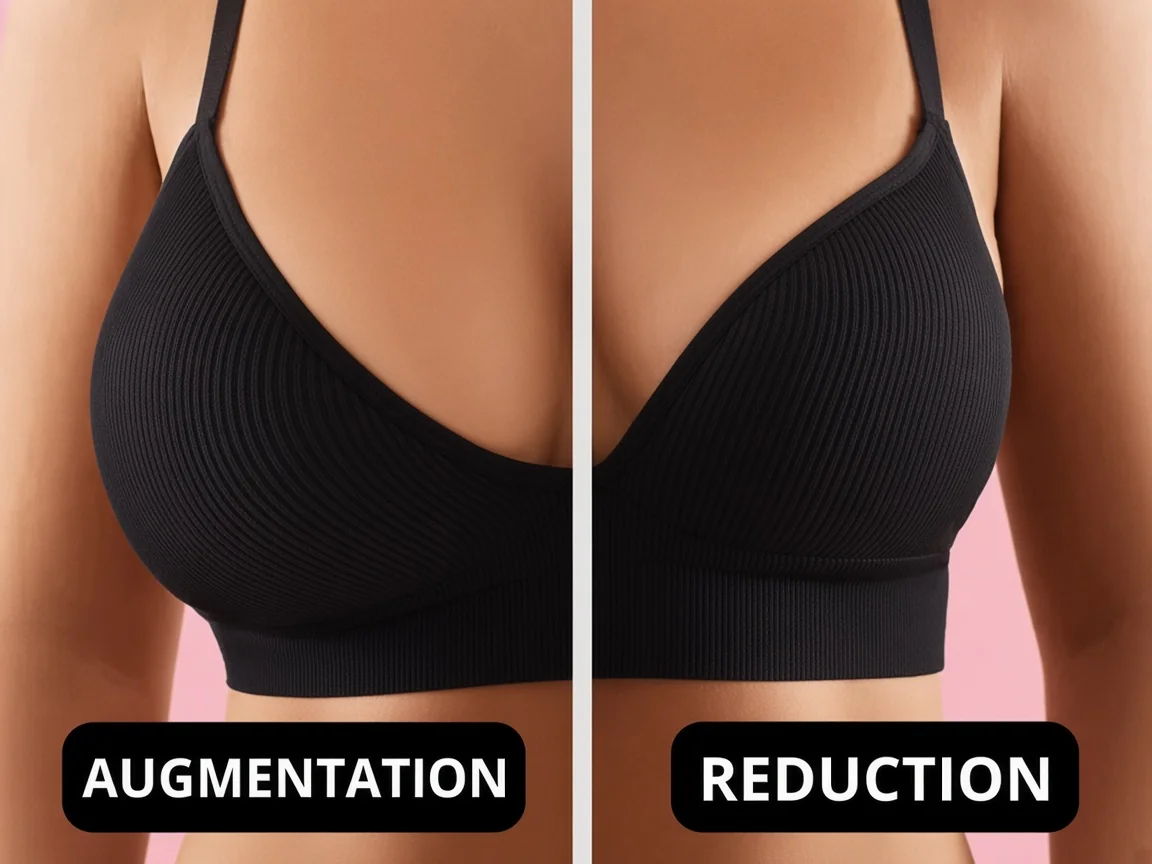
Looking for relief from heavy breasts and a shape that feels right for you?
Neck and back discomfort, shoulder grooves, and difficulty exercising can make large breasts feel like a daily burden. Breast reduction may help.
Breast hypertrophy carries a real burden of pain, functional impairment, and impact on quality of life. Reduction mammoplasty, in turn, has documented efficacy in relieving macromastia symptoms compared to non-surgical treatments. Women who have lived for years with chronic pain, postural scoliosis, recurrent fungal infections under the breasts, and embarrassment during physical activity find relief after surgery that goes beyond aesthetics. And what keeps these women from having surgery year after year is not the fear of the procedure itself. It's the fear of the scar.
Can breast reduction be done with shorter scars?
In some patients, shorter-scar techniques are possible. The best incision pattern depends on breast size, skin, and your goals.
Dr. Alexandre Charão prefers reduced-scar techniques, based on the most relevant scientific literature in Brazilian and international breast surgery.
SPAIR Technique — Short Scar Periareolar Inferior Pedicle Reduction
Described by Dr. Dennis Hammond, the SPAIR technique combines a periareolar incision with a short vertical component, eliminating the long horizontal scar of the conventional anchor technique. The inferior pedicle preserves the blood supply and innervation of the nipple-areola complex, and is indicated for small to large volume reductions with immediately rounded, well-defined results.
Vertical Technique — Hall-Findlay with Superomedial Pedicle
The vertical scar technique described by Dr. Elizabeth Hall-Findlay is a global reference in minimal-scar reduction mammoplasty. Professor Alexandre Munhoz, Head of Breast Surgery at Hospital Sírio-Libanês and USP, has published significant case series validating the superomedial pedicle as a safe and reproducible alternative for moderate to large volume reductions — preserving nipple sensitivity and delivering lasting results in therapeutic reduction.
Muscle Sling and Inferolateral Support — Brazilian Contribution
Drs. Marcelo T. Ono and Bruno M. Karner, from Londrina and Maringá, published studies in PRS Global Open on muscle support in mastopexy with implant (LAST technique)2 and, with collaborators, on the composite sling for inferolateral reinforcement — concepts Dr. Charão applies when shaping the implant pocket in combination with a reduction, aiming for greater long-term stability. Those considering a lift without a large volume reduction may also want to learn about mastopexy with reduced scarring.
The scar is a concern — but so is recovery. What is the post-op like?
With Fast Track Recovery, breast reduction recovery is much more comfortable than most people imagine.
Journalists from The Washington Post accompanied Dr. Charão in his surgical routine and highlighted his patient-centered and technically refined approach. In 2006, O Globo's "Faz a Diferença" (Makes a Difference) Award recognized the real impact of his work — and more than 200 real patient reviews on Google describe not only aesthetic results, but also relief from chronic pain, better posture and restored self-esteem.
Fast Track Recovery — a faster, more comfortable recovery and refined scars — is applied to every reduction mammoplasty, in line with accelerated recovery protocols in breast surgery1. The Weight-Loss and Metabolic Preparation Method begins as soon as the surgery is scheduled, aligned with perioperative nutritional and metabolic support guidelines, optimizing nutritional status for better healing. Each patient gets a private WhatsApp group with direct access to Dr. Charão throughout the post-op period.
All surgeries are performed at Hospital Glória D'Or, in the Glória neighborhood — part of the D'Or Network, the largest hospital network in Brazil, with annual Joint Commission International (JCI) accreditation.
Technical Comparison of Procedures
Understand the differences between conventional breast reduction and Dr. Alexandre Charão's approach:
| Criteria | Conventional breast reduction | Dr. Alexandre Charão |
|---|---|---|
|
Scar technique
|
• Inverted anchor (long scar) | ✓ SPAIR or vertical Hall-Findlay — significantly smaller scar |
|
Preserving sensitivity
|
• Variable without specific protocol | ✓ Superomedial pedicle preserving the innervation of the nipple-areola complex |
|
Result support
|
• Depends on sutures alone | ✓ Inferolateral muscle sling for long-term stability |
|
Result shape
|
• Depends on the technique and the surgeon | ✓ Round projection and shape preserved long-term |
|
Postoperative recovery
|
• 8 to 12 weeks of restrictions | ✓ Fast Track Recovery: faster, more comfortable recovery |
|
Preoperative preparation
|
• Fasting and basic lab tests | ✓ Weight-Loss and Metabolic Preparation Method |
|
Post-op monitoring
|
• Consultations at fixed intervals | ✓ Exclusive WhatsApp group with direct access to the doctor |
|
Surgical center
|
• Variable | ✓ Hospital Glória D'Or — D'Or Network, annual JCI accreditation |
Frequently Asked Questions
Straightforward answers about reduction mammoplasty with reduced scarring.
01 — Does breast reduction relieve back pain?
Yes. Breast hypertrophy is associated with pain and functional impairment, and studies have shown significant relief of macromastia symptoms after surgical reduction. Removing the excess volume relieves chronic muscle tension, improves posture and increases the capacity for physical activity — benefits that go far beyond aesthetics.
02 — What is the difference between the SPAIR technique and the vertical Hall-Findlay technique?
SPAIR uses a periareolar incision with a short vertical component and an inferior pedicle — indicated for large volumes with an immediately rounded result. Hall-Findlay, supported by a superomedial pedicle, uses a vertical scar — ideal for moderate to large volumes, with better long-term projection and less scar retraction. The choice depends on your anatomy and the volume to be reduced.
03 — Is nipple sensitivity preserved?
In the superomedial pedicle technique validated by Munhoz et al., preservation of the nipple-areola complex innervation is scientifically documented. Sensitivity may be temporarily reduced right after surgery, but tends to recover gradually over the following months.
04 — What is the inferolateral muscle sling, and why is it important?
It is a support technique described in the Brazilian literature by Ono, Karner and collaborators — including the LAST approach to mastopexy with implants and the composite sling for inferolateral reinforcement — that uses the abdominal portion of the pectoralis major muscle to support the implant or the reshaped gland. In reduction mammoplasty combined with an implant, it aims for greater long-term stability, preventing recurrent ptosis (sagging).
05 — Is it possible to breastfeed after breast reduction?
It depends on the volume removed and the technique used. Techniques with a vertical/superomedial pedicle preserve the milk ducts better than wider resections. Women of reproductive age planning a pregnancy should tell Dr. Charão during the consultation so the technique can be adjusted.
06 — How long does recovery take with Fast Track Recovery?
With Fast Track Recovery, aligned with accelerated recovery protocols in breast surgery, the return to light activities — such as working from home — takes 7 to 10 days on average. Moderate physical activity is gradually cleared from 4 weeks. The private WhatsApp group with Dr. Charão ensures continuous monitoring throughout recovery.
07 — Does Metabolic Preparation make a difference in scar quality?
Yes. Nutritional status at the time of surgery influences collagen synthesis and scar quality, according to perioperative nutritional and metabolic support guidelines. The Weight-Loss and Metabolic Preparation Method is especially relevant in reduction mammoplasty, where the length of the incisions makes healing a key factor in the final result.
08 — Where does Dr. Charão perform breast reduction?
At Hospital Glória D'Or, in the Glória neighborhood of Rio de Janeiro — part of the D'Or Network, with annual Joint Commission International (JCI) accreditation. The clinic welcomes patients from all over Brazil and abroad, with care in Portuguese, English and French.
Do you want real relief — with a smaller scar and direct follow-up from your surgeon?
Schedule your consultation with Dr. Alexandre Charão at Hospital Glória D'Or. The technique (SPAIR or Hall-Findlay) is chosen during the consultation, based on your anatomy.
Chat on WhatsApp nowReferences
- Seren JM, Cervantes A, Fontbona M, et al. A Decalogue on Enhanced Recovery After Breast Augmentation Surgery (ERABAS). Aesthetic Plast Surg. 2024. doi:10.1007/s00266-024-04231-7
- Ono MT, Karner BM. Four-step augmentation mastopexy: lift and augmentation at single time (LAST). Plast Reconstr Surg Glob Open. 2019;7(11):e2523. doi:10.1097/GOX.0000000000002523